|
Wednesday, 10 December 2008 22:55 |
Report wildlife crimes in your area! |
Send your report via SMS the Wildlife Crime Hotline at
019 356 4194 or email to the
This e-mail address is being protected from spambots. You need JavaScript enabled to view it
.
The Wildlife Crime Hotline is a 24-hour hotline to allow members of the public to easily report wildlife crimes. Once a call or SMS is received, each report is instantly channeled to the Department of Wildlife for action!
The need for a 24 hour hotline is clear: poachers and smugglers don’t just work between 9-5. The Hotline means there are more eyes and ears paying attention and able to provide timely information so that action can be taken against those who threaten our wildlife and break the law.
This is a great opportunity to help the authorities to catch the bad guys. | | | What information do we need? Nature of the incident (poaching, smuggling, keeping as a pet)
Location (Name of shop, address, brief directions/landmark)
Date and time
Name (optional)
*Images or video footage may assist the investigation. |
| | | | | | | | | | |
|
|
Last Updated on Tuesday, 13 October 2009 18:36 |
|
Read more...
|
|
National Tiger Action Plan |
 |
 |
 |
|
Wednesday, 10 December 2008 22:51 |
Using the collaborative platform of MYCAT, Department of Wildlife and National Parks (DWNP) organized and hosted the Malayan Tiger Conservation Workshop in November 2006 with the aim of developing a National Tiger Action Plan for Malaysia.
This Plan is the common roadmap detailing the direction and specific actions required between 2008 and 2015 to secure a future for wild Malayan tiger populations.
The aim of the Plan is to establish a holistic but focused and achievable conservation strategy which lays out specific actions to be taken over the next eight years (Phase I: 2008 - 15) towards an overarching vision of securing viable tiger populations in Malaysia for the next century and beyond. The Plan was developed around existing government policies and legislative structures relevant to wildlife conservation.
Through this plan, the Malaysian government has the opportunity to present healthy tiger populations as an exemplar of its on-going efforts to develop economically in a sustainable manner, rather than the Malayan tiger becoming another symbol of the systematic loss of tropical forest and an ecosystem in crisis.
The goal for 2020 identified in this National Tiger Action Plan for Malaysia is: Tiger populations actively managed at carrying capacities across the three landscapes within the Central Forest Spine and connected with functioning corridors. | | | 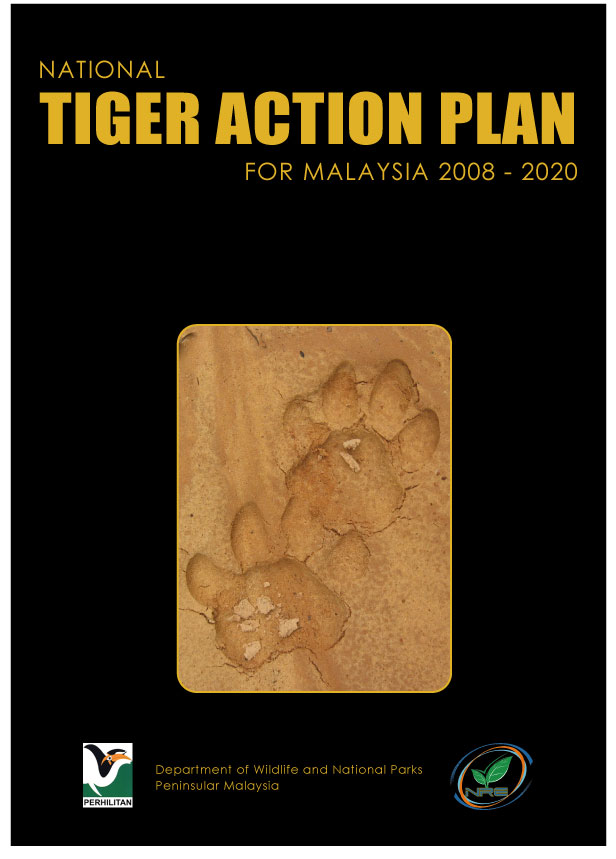
© Department of Wildlife and National Parks | | | | | |
The Tiger Action Plan further outlines priority outcomes for each of the objectives and translates these conservation objectives and desirable outcomes into concrete actions, responsible agencies, measurable indicators and realistic time-frames. These details lay out the first phase of the Plan to be carried out between 2008 and 2015; dates that deliberately coincide with the 9th and 10th Malaysian Plans.
The importance of accountability and transparency in conservation actions within the Tiger Action Plan is implicit, with an in-built evaluation and learning mechanism for a continued process of implementation. The overall indicator of success, or the Plan’s measurable target, is about 1,000 wild tigers surviving on wild prey in the Central Forest Spine by the year 2020.
The success of this conservation strategy must be reflected in the known status of the distribution and density of the tiger populations in Malaysia. In order to use these indicators, we must first establish a base-line so that we can monitor our efforts to stabilise, increase and manage tiger numbers.
By doing this, we hold ourselves accountable to the wild tigers; the importance of conservation science, the fourth objective of the plan, becomes imperative. Applying scientific methods to measure the effectiveness of conservation actions allows us to best use the resources we have available.
This increases the accountability and transparency in the conservation actions we take. | | | As the custodian of the Plan, DWNP has the responsibility of implementing many of the identified actions. DWNP, in collaboration with NGOs and other government agencies, takes the lead in implementing 59 of the 80 planned actions.
Other government agencies that lead actions include the Economic Planning Unit, Ministry of Natural Resources and Environment, Department of Town and Country Planning, Forestry Department, state land authorities, Perak State Park Corporation and Johor National Parks Corporation.
Eight actions are led and implemented by various NGOs, namely the Malaysian Nature Society, TRAFFIC Southeast Asia, Wildlife Conservation Society and WWF-Malaysia. Implementing the full Plan is a responsibility shared by many organisations. |
|
|
|
Last Updated on Saturday, 04 April 2009 15:11 |
|
|
Wednesday, 10 December 2008 22:22 |
| | Tigers are found throughout much of Peninsular Malaysia (except for islands and small states such as Perlis, Penang, Malacca and the federal territories of Kuala Lumpur and Putrajaya).
Tigers are habitat generalists, meaning that they can live in a variety of habitat types; from peat swamp to small woodlands inside plantations to lower montane forest. In Malaysia, tigers are even found at the Gunung Bintang Hijau at 1730m in Perak. However, they prefer lowland forest.
Based on the information collected between 1991 and 2003, about half of Peninsular Malaysia is considered a suitable tiger habitat. The four main tiger states are Pahang, Perak, Kelantan and Terengganu and these support nearly 90% of the tiger habitat in the country.
Accurately estimating the number of tigers left in Malaysian forests is almost impossible; tigers are very secretive and rarely seen.
Based on the knowledge of average numbers of tigers that can be supported by tropical forests, the tiger’s energy needs, and the preceding tiger distribution map, a potential population size of the Malayan tiger ranges from 500 to 1500 tigers.
Generally the lower bound of 500 is cited as a current population figure as it corresponds with the official figure used since 1990. In reality however, it is difficult to know.
During the 1970s, attitudes changed and the fortune of the tiger in Malaysia took a turn for the better with its listing as a “totally protected species” under the Protection of Wild Life Act 1972.
This law made it illegal to kill or possess body parts of a tiger. Many of the tiger’s prey species such as the sambar deer, barking deer and wild pig are also listed on the same law as “protected species”, meaning that hunting is only allowed with a license.
Worldwide, the tiger is considered as Endangered by the IUCN Red List. Trade of threatened wildlife across national boundaries is regulated by the Convention on International Trade in Endangered Species of Wild Fauna and Flora (CITES).
Malaysia is a signatory to CITES which lists the tiger as an Appendix 1 species, meaning that all international commercial trade in live tigers and parts and products made from tigers is strictly prohibited.
However, this protected status has only slowed down rather than reversed the decline in tiger numbers.
Within Malaysia, tigers are found only on the peninsula, which has around 45% of its forest cover remaining. Between 1991 and 2003, tigers were confirmed to be present in 30% of the land area which can be divided into three main forest landscapes. These forest landscapes form the basis of spatial planning for Malaysia’s tiger conservation. | | | | | Unique sub-species
Malaysia has its own unique sub-species of tiger – the Malayan tiger Panthera tigris jacksoni, named after renowned tiger conservationist Peter Jackson, in honour of his years of work for tigers.
The sub-species previously included as Indochinese Tiger P. t. corbetti is now divided into two groups: one in northern Indochina and the other in the Malay Peninsula, which encompasses the southern end of Thailand and Peninsular Malaysia.
Scientists from the National Cancer Institute's Laboratory of Genomic Diversity in USA conducted DNA analysis from various samples of blood, skin and hair from 134 captive tigers across Asia. Some of the specimens used in the study were obtained from tigers that were captured by DWNP in human-tiger conflict situations; genetically pure tigers.
The scientists discovered that the tiger found here is unique only to the Malay Peninsula.
While acknowledging the exciting new discovery, the Malaysian government recommends that this sub-species be named P. t. malayensis to reflect its geographic distribution. More recently, however, a morphological study has questioned the validity of this classification.
For more information, please download the Malayan tiger information sheet. | | | | Tiger Distribution in Malaysia | | |  Source: Department of Wildlife and National Parks Peninsular Malaysia, 2005 |
| | | | | | | | | | |
| Malaysia's Tiger Landscape | | | 
Source: Department of Wildlife and National Parks Peninsular Malaysia, 2008. National Tiger Action Plan for Malaysia.
| | |
The Main Range Landscape
Located to the west of the mainland running from the Malaysia-Thai border to Negeri Sembilan. | | The Greater Taman Negara
Located to the east, which includes Taman Negara National Park; the country’s largest protected area. | | The Southern Forest Landscape
Found south of the Pahang River, but isolated from both the former landscapes. |
Each of these forest landscapes has a priority core area for tiger conservation: Belum-Temengor Complex, Taman Negara, and the Endau-Rompin Complex, respectively. These landscapes are vital to tiger conservation, but it is also important that such areas are connected by “ecological corridors” which would prevent small populations of tigers becoming isolated from others. Small populations will become inbred if they cannot mix with others from other areas – and cannot survive in the long term.
The identification and protection of the priority ecological corridors will increase the potential of the tiger landscapes to conserve tigers in Malaysia by allowing the continued dispersal of tigers within these landscapes. | | | | | These are areas where habitat restoration and management can maintain connectivity between: Belum-Temengor, Taman Negara-Lebir-Tembat, and Endau-Rompin-Mersing, respectively.
One critical linkage that still exists and must be actively maintained and enhanced to ensure that these vital landscapes remain connected is a narrow strip of forest connecting the Main Range and Taman Negara (near the western border of the park in Pahang). Existing and proposed infrastructure projects, such as roads, railways, and a major oil pipeline threaten the connectivity of habitats within and between all these areas. Mitigation measures are available to counter the risk of fragmentation if these are incorporated into the first stages of planning projects which may block the corridors. |
|
|
Last Updated on Tuesday, 13 October 2009 18:44 |
|



