|
Written by Suzalinur Manja Bidin
|
|
Friday, 20 February 2009 13:09 |
The tiger Panthera tigris is the world’s largest cat, found only in Asia. There are six sub-species of tiger; with the Siberian Tiger being the largest growing up to 3.3m long and weighing 300kg. The Sumatran tiger is the smallest sub-species, averaging 2.4m long and 120kg. Tigers thrive in areas with dense vegetation, an ample source of water and large populations of ungulates.
They are found in a variety of habitats, including grassland, coniferous, deciduous, and tropical forests, as well as mangroves and swamps. Tigers are top predators able to prey on mammals up to five times their own weight. | | | | In India and Nepal the alluvial grasslands support many types of large ungulates in abundance. The tropical forests of Southeast Asia do not support large herds of deer, antelope and cattle and in Malaysia, their main natural prey species are wild pig, barking deer and sambar deer, but can include smaller animals such as porcupine, mouse deer, and macaque.
Tigers are solitary most of the time. Small groups of related adults may hang around together occasionally and males and females will come together to mate. Mating occurs throughout the year, with females giving birth to a litter of two or three cubs which will stay with their mother for about two years. During this time they learn how to hunt and avoid danger. |
| Historic and present distribution of tigers | | | 
© Save The Tiger Fund |
It is estimated that tiger populations have declined by 97% over the past hundred years. Loss of habitat and poaching of both tigers and their prey have brought this iconic species to the brink of extinction.
Today the remaining 3,000 tigers are scattered in around 70 pockets of forests across 14 countries - some of these populations too small to survive in the long run.
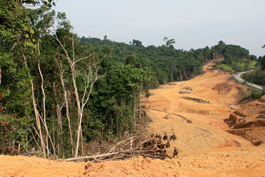
In Malaysia and the other countries where tigers occur, habitat loss, forest fragmentation, poaching, illegal trade of tiger parts and derivatives, depletion of prey species and the conflict with people are the main threats to tigers.
Indirect threats include retaliatory killing or removal by the authorities after conflict, killings from snares set for other wildlife, poor livestock and plantation management and a lack of public awareness and support. | | | | | | 
© Wild Aid Thailand |
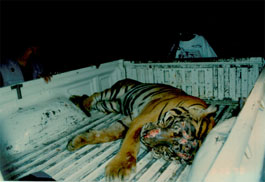
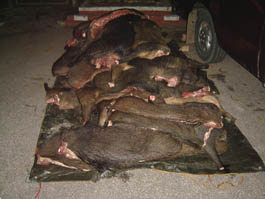
| | Poaching for consumption is an increasing threat in Malaysia and elsewhere. Almost every body part of the tiger is thought by some to have curative or ‘magical’ powers. Its meat is served as a delicacy in exotic meat restaurants and other body parts such as the teeth, claws and skin are also sought after. Monitoring the number of tigers which are killed each year is very difficult. |
|
|
Last Updated on Tuesday, 13 October 2009 17:00 |
|
News update! | | | | | Tiger rescue points to urgent need for more patrols
4 October 2009
A Malayan tiger was freed from a snare by the Department of Wildlife and National Parks after it was discovered in Perak’s Belum forest by WWF’s Wildlife Protection Unit. The rescued tiger has been sent to Malacca Zoo, for its horrific snare wounds to be treated.
Click here for the full story. | | | | | | | | |
| | | | | Boney-M is coming to town ... and performing for Malayan tigers!
Thanks to the Lejadi Group’s Carin’ and Sharin’ Thro Music event, legendary band Boney-M will be taking the stage here in Malaysia on the 28th of November, and part of the proceeds will be generously donated to MYCAT. Come enjoy the music, and make a contribution to tigers at the same time!
For details, click here. | | |
Join us on facebook! 
|
| | | | | |
Plight of the tiger | | | | | | There are less than 3,000 tigers left roaming the planet, a drastic decline from 100,000 tigers just a short century ago.
There used to be nine tiger sub-species worldwide, but in the last 70 years, three have gone extinct - the Balinese, Caspian and Javan. Globally, the tiger has lost 93% of its habitat in the last 100 years.
The Malayan tiger Panthera tigris jacksoni found only in the Malay Peninsula, was recognized in 2004 as the ninth sub-species. In the 1950s, there were an estimated 3,000 tigers in Peninsular Malaysia. Today, only about 500 Malayan tigers are believed to remain, but no one knows for certain.
The initial decline in tiger numbers was primarily due to large-scale loss of habitat but in more recent times, the most urgent threat is poaching for its body parts, persecution by angry villagers, and starvation as their prey is over-harvested.
Threats to the survival of wild tigers are mounting and a world without wild tigers may become a reality in our lifetime unless drastic measures are taken.
The tiger is endangered. It is in trouble, and the time to save the tiger is now or never. The Malayan tiger needs greater interest, concern and action from the Malaysian public.
More Malaysians must join the fight to save the tiger. It may not take much to push our tiger closer to extinction, but Malaysia must act urgently if we are to save our national icon of strength, beauty and courage. | | | | |
|
|
|
Malaysian Conservation Alliance for Tigers (MYCAT) |
 |
 |
 |
Challenges to tiger conservation are multi-faceted and finding solutions to the problems faced by the species requires an integrated conservation approach, which is the foundation of the establishment of MYCAT in September 2003.
MYCAT is the joint programme of the Malaysian Nature Society, TRAFFIC Southeast Asia, Wildlife Conservation Society - Malaysia Programme and WWF-Malaysia, supported by the Department of Wildlife and National Parks Peninsular Malaysia for joint implementation of the National Tiger Action Plan for Malaysia. |
Vision
A 22nd Century Malaysia in which viable populations of tigers thrive in the wild in perpetuity.
Goal
Tiger populations actively managed at carrying capacities across the Central Forest Spine and connected with functioning corridors.
Objectives Secure the Central Forest Spine with protected core areas linked within the greater landscape by ecological corridors. Provide effective protection for tigers and their prey from poaching and trade. Promote the practice of ecologically sound land-use, compatible with tiger conservation, outside protected areas. Apply sound science in monitoring the efficacy of conservation actions and improving the knowledge of tiger ecology. |
| MYCAT Working Group | | | | | | | The MYCAT Working Group (WG) comprises the MYCAT Secretariat’s Office and representatives from the partner organizations to MYCAT and operates in a flexible manner to accommodate the changing needs and priorities within the stipulated objectives and principles of MYCAT. | | The Working Group meets each quarter to ensure all partners are updated on the progress of the implementation of the National Tiger Action Plan, to discuss emerging issues and to make collective decisions on MYCAT operations and joint projects. The WG members are responsible for communication within their respective organizations with regards to MYCAT activities. |
| | | | | | MYCAT Secretariat's Office | | | | | | | | Facilitates communication between the partners. Coordinates collaborative efforts and manages joint projects. Assist the Ministry of Natural Resource and Environment in monitoring the implementation of the National Tiger Action Plan. Consolidates information from the partners to disseminate to the public. Provides technical support on request, especially to the partners and government agencies. | | | | | |
|
|
MYCAT Partners  | | Malaysian Nature Society (MNS)
MNS is the oldest and largest membership-based non-government organization in Malaysia with a mission to promote the study, appreciation, conservation and protection of Malaysia’s natural heritage. Working closely with governments, private and civil societies, the Society’s core areas include policy and advocacy for habitats and species, involving local communities in environmental education with a strong student programme, as well as addressing Multilateral Environmental Agreement concerns. | | | | |  | | TRAFFIC Southeast Asia (TRAFFIC)
TSEA is the regional office of TRAFFIC; the international wildlife trade monitoring network. Its mission is to ensure that trade in wild plants and animals is not a threat to the conservation of nature. TRAFFIC helps ensure that wildlife trade is carried out at sustainable levels and in accordance with domestic and international laws and agreements. This is achieved through the investigation, monitoring and reporting of such trade, particularly that which is both potentially detrimental to the survival of flora and fauna and illegal. | | | | |  | | Wildlife Conservation Society Malaysia Programme (WCS)
WCS Malaysia Programme works to save wildlife and wild lands through careful science, conservation education and support for conservation efforts by the government, private sector and civil society. Together, these activities change individual attitudes toward nature and help people imagine wildlife and humans living in sustainable interaction on both a local and a global scale. | | | | |  | | WWF-Malaysia
WWF-Malaysia, the national conservation trust, is committed to safeguarding our country’s natural resources and unique wildlife for all Malaysians. Since 1972, WWF-Malaysia has worked on important conservation projects, from saving endangered species such as tigers and turtles, to protecting our highland forests, rivers and seas. WWF’s mission is to stop the degradation of the natural environment and to build a future in which humans live in harmony with nature by conserving the world’s biological diversity, ensuring that the use of renewable natural resources is sustainable and promoting the reduction of pollution and wasteful exploitation consumption. |
Supported by  | | Department of Wildlife and National Parks Peninsular Malaysia (DWNP)
DWNP, under the Ministry of Natural Resource and Environment, is Peninsular Malaysia’s wildlife authority with the mission to spearhead, coordinate and implement the conservation and sustainable management of the nation’s tropical biological diversity whilst ensuring the sustainable development of the nation towards a fully developed status. |
Supporters | | MYCAT core operations have received financial support from the Malaysian Government, U.S. Fish and Wildlife Service, Save the Tiger Fund and WWF-International Tiger Programme.
Additionally, MYCAT joint projects have been funded by the Save the Tiger Fund, U. S. Fish and Wildlife Service, 21st Century Tiger, ExxonMobil Malaysia, Dickerson Park Zoo, the Malaysian Government, WWF-Malaysia, TRAFFIC Southeast Asia, elc International School, Garden International School, International School of Kuala Lumpur and Benchmarx (Rockin' for the Environment: Tiger Rock 2008), St. Patrick's Society of Selangor and The Alice Smith International School.
In executing the various joint projects, we also received in-kind support in the form of goods and services from Aniza Yusup, Chin Pik Wun, Dial M for Dance, FLYfm, Hotfm, John Hill, Johor National Parks Corporation, Krisaru, Loh Chan Wai, Maryanne Masilamany, Mohd Razali Isa, MY FM, Nature Owlet, Ning Baizura, Novista TV, Penguin Books, Phoenix Fund, Ribena, Salt Media Consultancy, Tamarind Springs, Tiger Junior Rangers, UPM FPV Zoologico Charity Event 2008, Wildlife Protection Society of India, Wildtrack Photography, Yeo Hiap Seng Trading Sdn Bhd, Zoo Melaka, Zoo Negara, Zoo Outreach Organisation, 8TV, 9 Lives Communications, Vince Chong, volunteers, media, and members of the public.
MYCAT partner organisations receive support for their respective tiger projects from donors not listed here but on their respective websites. | | |
To make donations towards MYCAT joint projects, please contact us. |
|
|
Frequently Asked Questions |
|
|
|
|
Wednesday, 10 December 2008 22:57 |
| | Why are tigers being killed? Almost every body part of the tiger is sought after for traditional medicines, magic, trophies, and exotic meat restaurants. Some cultures have a long history of using the species in a variety of traditional concoctions made from almost every part of the animal. Even here in Malaysia exotic meat restaurants claim to serve meat from tigers and other endangered wildlife, with consumers often believing that these are good for their health.
| | | | | | Do people ‘need’ to take medicines made from tiger parts? It is possible that this “need” existed in ancient times. But today, in additional to modern medicines there are also many herbal alternatives to assist those suffering from the conditions that tiger-based medicine supposedly cure, such as rheumatism and arthritis. These alternatives are safe and legal, and are recommended by many traditional medicine practitioners.
| | | | | | Should tigers be commercially bred and farmed to supply the demand? Some argue that farming tigers could be a good idea. It might take the pressure away from wild populations, with farmed animals supplying the demand for tiger parts and products. We firmly oppose such a move. Commercial tiger farming violates both local and international laws. The demand for products made from wild tigers would increase since these would be considered by consumers to be more valuable and powerful than those from farmed individuals. A black market would quickly develop for products made from wild tigers, leading to the rapid demise of the remaining wild animals. The 500 or so wild tigers remaining in Malaysia could be wiped out within a short period of time. It doesn’t make economic sense. It will always be cheaper to obtain tigers by setting snares and shooting them, rather than breeding, feeding and caring for them. The cost of a wire snare is next to nothing in comparison to the cost of maintaining one tiger for three years when it would be old enough to attain adult bone weight, which can be as much as RM70,000. Protecting tigers is difficult enough - without having to prove if a product came from a farmed tiger, or a wild one. We need to step up and protect our wild tigers, rather than feed the demand for tiger products. We cannot save the tiger by selling it.
| | | | | | Do wild tigers have enough food to survive on? In Malaysia, sambar deer, barking deer and wild pig are important tiger prey species. People too, share the same taste for these animals, hunting them, reduces the amount of food available for tigers. sambar deer, barking deer and wild pig can be hunted and sold only with a license. Wild pigs can be hunted throughout the year, but barking deer and sambar deer can only be legally hunted during the month of November. If you see anyone hunting deer outside this period, they are breaking the law and should be reported. The sale of deer meat, however, is more complicated with some markets and restaurants selling farmed deer which is legal throughout the year. Not every restaurant serving deer meat is breaking the law - unless you are sure that their meat is illegally sourced from the wild.
| | | | | | Why do tigers attack people and domestic livestock?
Tigers are losing their wild places as development increases and the human population grows. When people and tigers live too close to each other, conflict can arise. Tigers may attack domestic livestock (especially if the populations of wild prey have been reduced), or sometimes, accidentally attack people. When this happens, tigers are removed by the authorities or killed in retaliation by villagers. More tigers are killed by people than the other way around.
| | | | | | Does Malaysia have enough space for wild tigers to survive and thrive? Much of Malaysia’s virgin lowland rainforests have been cleared and converted to agriculture. Less than 4% of Peninsular Malaysia’s virgin rainforests remain untouched; with about 45% of the land as forest cover. Taman Negara holds a viable population of tigers and it is likely that the Belum-Temengor forest in Perak still supports a viable population. Wild Malayan tigers will only stand a chance of surviving into the next century if these contiguous large forests remain. This is why it is vital that these large blocks of forest remain intact, with their inhabitants safe from poachers.
| | | | | | But don’t we have thousands of tigers in zoos all over the world? Will tigers really disappear? There are more than 5,000 tigers living in zoos worldwide - more than in the wild! Saving the tiger isn’t just about conserving those living behind bars. The tiger means wildness – they need large expanses of forests with lots of other wildlife (and few people). From their position at the top of the food chain, tigers exert significant predatory pressure - they help to keep the ecosystem in balance. Forests with large predators support a greater variety of species than those without. Zoos cannot conserve healthy ecosystems.
| | | | | | What is the Tiger Crime Hotline?
The Tiger Crime Hotline is a 24-hour hotline to allow members of the public to easily report wildlife crimes, especially those which relate to tigers. Once a call or SMS is received, each report is instantly channeled to the Department of Wildlife for action! The need for a 24 hour hotline is clear: poachers and smugglers don’t just work between 9-5 ! The Department of Wildlife has Wildlife Crime Units throughout the country, but they can’t be everywhere at once. The Tiger Crime Hotline means there are more eyes and ears paying attention and able to provide timely information so that action can be taken against those who threaten our wildlife and break the law. We can’t afford to lose even one Malayan tiger – there are only 500 left in the wild. This is a great opportunity to help the authorities to catch the bad guys … and you can say you were part of the efforts to save the tiger!
| | | - What information do we need?
- Nature of the incident (poaching, smuggling, keeping as a pet)
- Location (Name of shop, address, brief directions/landmark)
- Date and time
- Name (optional)
- *Images or video footage may assist the investigation.
If the information you provide leads to a successful arrest and prosecution, you may receive a cash reward.
|
|
|
Last Updated on Thursday, 05 March 2009 11:33 |
|