Friday 16th of October 2009
|
National Tiger Action Plan |
 |
 |
 |
Using the collaborative platform of MYCAT, Department of Wildlife and National Parks (DWNP) organized and hosted the Malayan Tiger Conservation Workshop in November 2006 with the aim of developing a National Tiger Action Plan for Malaysia.
This Plan is the common roadmap detailing the direction and specific actions required between 2008 and 2015 to secure a future for wild Malayan tiger populations.
The aim of the Plan is to establish a holistic but focused and achievable conservation strategy which lays out specific actions to be taken over the next eight years (Phase I: 2008 - 15) towards an overarching vision of securing viable tiger populations in Malaysia for the next century and beyond. The Plan was developed around existing government policies and legislative structures relevant to wildlife conservation.
Through this plan, the Malaysian government has the opportunity to present healthy tiger populations as an exemplar of its on-going efforts to develop economically in a sustainable manner, rather than the Malayan tiger becoming another symbol of the systematic loss of tropical forest and an ecosystem in crisis.
The goal for 2020 identified in this National Tiger Action Plan for Malaysia is: Tiger populations actively managed at carrying capacities across the three landscapes within the Central Forest Spine and connected with functioning corridors. | | | 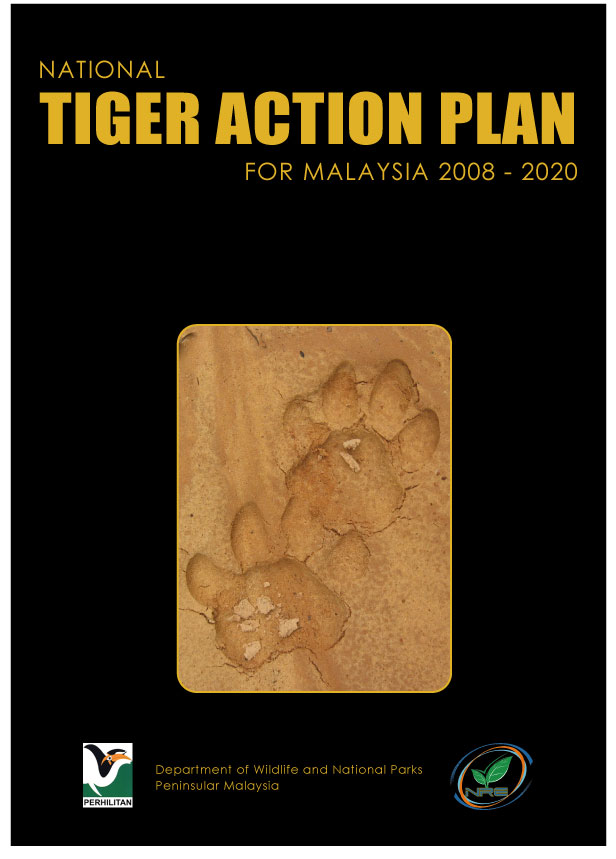
© Department of Wildlife and National Parks | | | | | |
The Tiger Action Plan further outlines priority outcomes for each of the objectives and translates these conservation objectives and desirable outcomes into concrete actions, responsible agencies, measurable indicators and realistic time-frames. These details lay out the first phase of the Plan to be carried out between 2008 and 2015; dates that deliberately coincide with the 9th and 10th Malaysian Plans.
The importance of accountability and transparency in conservation actions within the Tiger Action Plan is implicit, with an in-built evaluation and learning mechanism for a continued process of implementation. The overall indicator of success, or the Plan’s measurable target, is about 1,000 wild tigers surviving on wild prey in the Central Forest Spine by the year 2020.
The success of this conservation strategy must be reflected in the known status of the distribution and density of the tiger populations in Malaysia. In order to use these indicators, we must first establish a base-line so that we can monitor our efforts to stabilise, increase and manage tiger numbers.
By doing this, we hold ourselves accountable to the wild tigers; the importance of conservation science, the fourth objective of the plan, becomes imperative. Applying scientific methods to measure the effectiveness of conservation actions allows us to best use the resources we have available.
This increases the accountability and transparency in the conservation actions we take. | | | As the custodian of the Plan, DWNP has the responsibility of implementing many of the identified actions. DWNP, in collaboration with NGOs and other government agencies, takes the lead in implementing 59 of the 80 planned actions.
Other government agencies that lead actions include the Economic Planning Unit, Ministry of Natural Resources and Environment, Department of Town and Country Planning, Forestry Department, state land authorities, Perak State Park Corporation and Johor National Parks Corporation.
Eight actions are led and implemented by various NGOs, namely the Malaysian Nature Society, TRAFFIC Southeast Asia, Wildlife Conservation Society and WWF-Malaysia. Implementing the full Plan is a responsibility shared by many organisations. |
|
|
| MYCAT Secretariat’s Office, |
|
| c/o TRAFFIC Southeast Asia, |
T: +6 03 7880 3940 |
| Unit 3-2, 2nd Floor, Jalan SS 23/11, |
F: +6 03 7882 0171 |
| Taman SEA, 47400 Petaling Jaya, |
M: +6 012 3100 594 |
| Selangor, Malaysia |
E: [email protected] |
Copyright © 2009 Malayantiger.net |
Powered by KRISARU



